
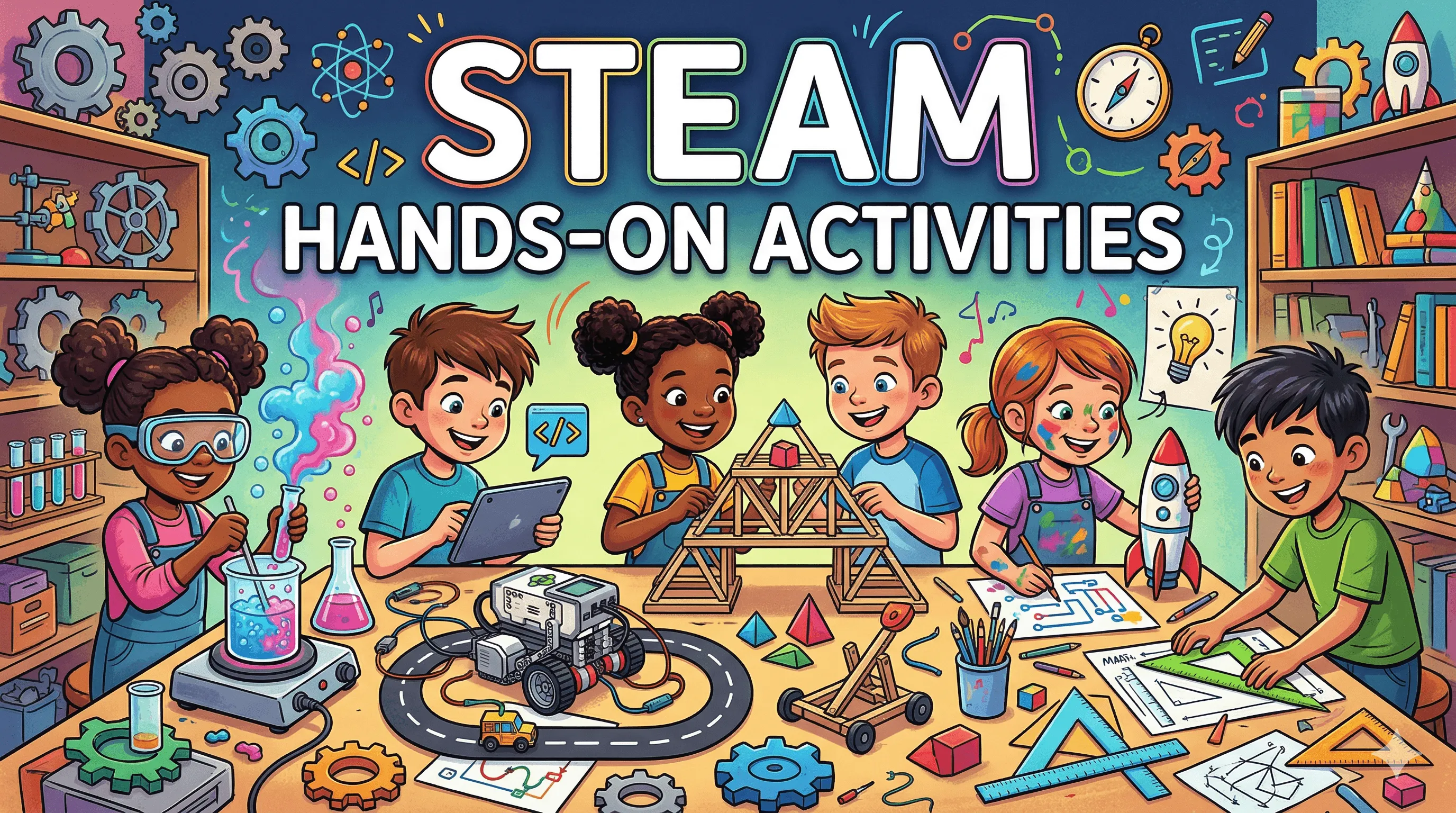
STEAM Hands-on Activities
STEAM hands-on activities curriculum featuring 16 engaging projects covering robotics, engineering, chemistry, physics, and creative problem-solving with step-by-step instructions.
16 Exciting Projects
Explore robotics (Lego robots, marble maze), engineering (bridges, catapults), chemistry (slime, volcanos), and physics (balloon rockets, paper airplanes).
Step-by-Step Learning
Each activity includes clear materials list, detailed instructions, scientific concepts explained, and guided questions for deeper understanding.
Creative Problem-Solving
Build critical thinking through design challenges like pasta towers, magnetic mazes, code breaking, and engineering solutions to real-world problems.
Course Sessions
1 Session 1
Milk the Cow
Session 1
Milk the Cow
- Materials: Rubber glove, Water or milk, A cup
- Science Concepts: Gravity, Push and pull
- Book: A Birthday for Cow! by Jan Thomas
2 Session 2
Water Suspension
Session 2
Water Suspension
- Materials: Large bowl of water, Food coloring, Small clear drinking glass
- Science Concepts: Pressure, Gravity
- Book: Miss Smith Under the Ocean by Michael Garland
3 Session 3
Don''t Topple the Teepee Fine Motor
Session 3
Don''t Topple the Teepee Fine Motor
- Materials: Sticks (chopsticks, wooden skewers, etc.), A loop to place the sticks inside
- Science Concepts: Forces, Interactions
- Book: Machines at Work by Byron Barton
4 Session 4
Leak Proof Bag
Session 4
Leak Proof Bag
- Materials: Gallon size storage bag, Sharpened pencils
- Science Concepts: Forces, Interactions, Polymers
- Book: Goodnight, Goodnight Construction Site by Sherri Duskey Rinker
5 Session 5
Skittles Rainbow Science
Session 5
Skittles Rainbow Science
- Materials: White plate, Warm water, Skittles
- Science Concepts: Dissolve, Diffusion, Interactions
- Book: Planting a Rainbow by Lois Ehlert
6 Session 6
Rainbow Walking Water Science
Session 6
Rainbow Walking Water Science
- Materials: 6 identical cups or jars, Paper towels, Food coloring, Water
- Science Concepts: Dissolve, Diffusion, Adhesion, Interactions
- Book: Mouse Paint by Ellen Stoll Walsh
7 Session 7
Lava Lamp
Session 7
Lava Lamp
- Materials: Clean plastic bottle, Vegetable oil, Fizzing tablets (Alka Seltzer), Food coloring, Water
- Science Concepts: Dissolve, Dense, Interactions
- Book: Fire Truck by Peter Sis
8 Session 8
Floating Egg
Session 8
Floating Egg
- Materials: Two glasses 2/3 full of water, Salt, Two eggs
- Science Concepts: Dissolve, Density
- Book: Ready for Anything! by Keiko Kasza
9 Session 9
The Pepper and Soap
Session 9
The Pepper and Soap
- Materials: Plate or bowl, Dish soap, Black pepper, Water
- Science Concepts: Surface tension, Hydrophobic, Dissolve, Interactions
- Book: Press Here by Herve Tullet
10 Session 10
Refraction of Light
Session 10
Refraction of Light
- Materials: Piece of paper, Marker, Glass or jar, Water
- Science Concepts: Refraction
- Book: Found by Salina Yoon
11 Session 11
Making Your Own Rainbow
Session 11
Making Your Own Rainbow
- Materials: Shallow pan, Flashlight or sunlight, White surface or piece of paper, Mirror, Water
- Science Concepts: Refraction, Reflection
- Book: Dog's Colorful Day by Emma Dodd
12 Session 12
Floating Dry Erase
Session 12
Floating Dry Erase
- Materials: Glass plate/bowl/picture frame, Dry erase marker, Water
- Science Concepts: Dissolves, Neutralization reaction
- Book: Blue Sea by Robert Kalan
13 Session 13
Dancing Raisins
Session 13
Dancing Raisins
- Materials: Raisins, Two clear glasses, Rubber wrap, Carbonated water and regular tap water
- Science Concepts: Sink, Density
- Book: Five Little Monkeys Jumping on the Bed by Eileen Christelow
14 Session 14
Making Music with Water
Session 14
Making Music with Water
- Materials: 5 or more drinking glasses or glass bottles, Wooden stick (pencil), Water
- Science Concepts: Vibration, Wave, Speed
- Book: The Doorbell Rang by Pat Hutchins
15 Session 15
Magic Star
Session 15
Magic Star
- Materials: 5 toothpicks, Small plate, Medicine dropper, Water
- Science Concepts: Capillary action, Adhesive forces
- Book: Happy Birthday Moon by Frank Asch
16 Session 16
Invisible Ink with Lemon Juice
Session 16
Invisible Ink with Lemon Juice
- Materials: Lemon (1/2), Small bowl, Cotton swabs, Paper, Heat source
- Science Concepts: Chemical reaction, Acids
- Book: Bunny Mail by Rosemary Wells
Key Details
Develop an understanding of the four disciplinary core ideas: Physical sciences; Life sciences; Earth and Space sciences; and Engineering, Technology, and Applications of science. In the earlier grades, students begin by recognizing patterns and formulating answers to questions about the world around them. Students can demonstrate grade-appropriate proficiency in gathering, describing, and using information about the natural and designed world(s).
STEAM Activities Overview
This curriculum features 16 hands-on science experiments designed to engage young learners in exploring fundamental scientific concepts through playful, interactive activities. Each session includes materials needed, key science concepts, an instructional video link, and a recommended children’s book.
Additional Resources
Other books list available from Kmind: https://drive.google.com/drive/folders/1sa7hTChsSwvYrTaVvkfHi15U6zlO9aes?usp=sharing