Grade 1
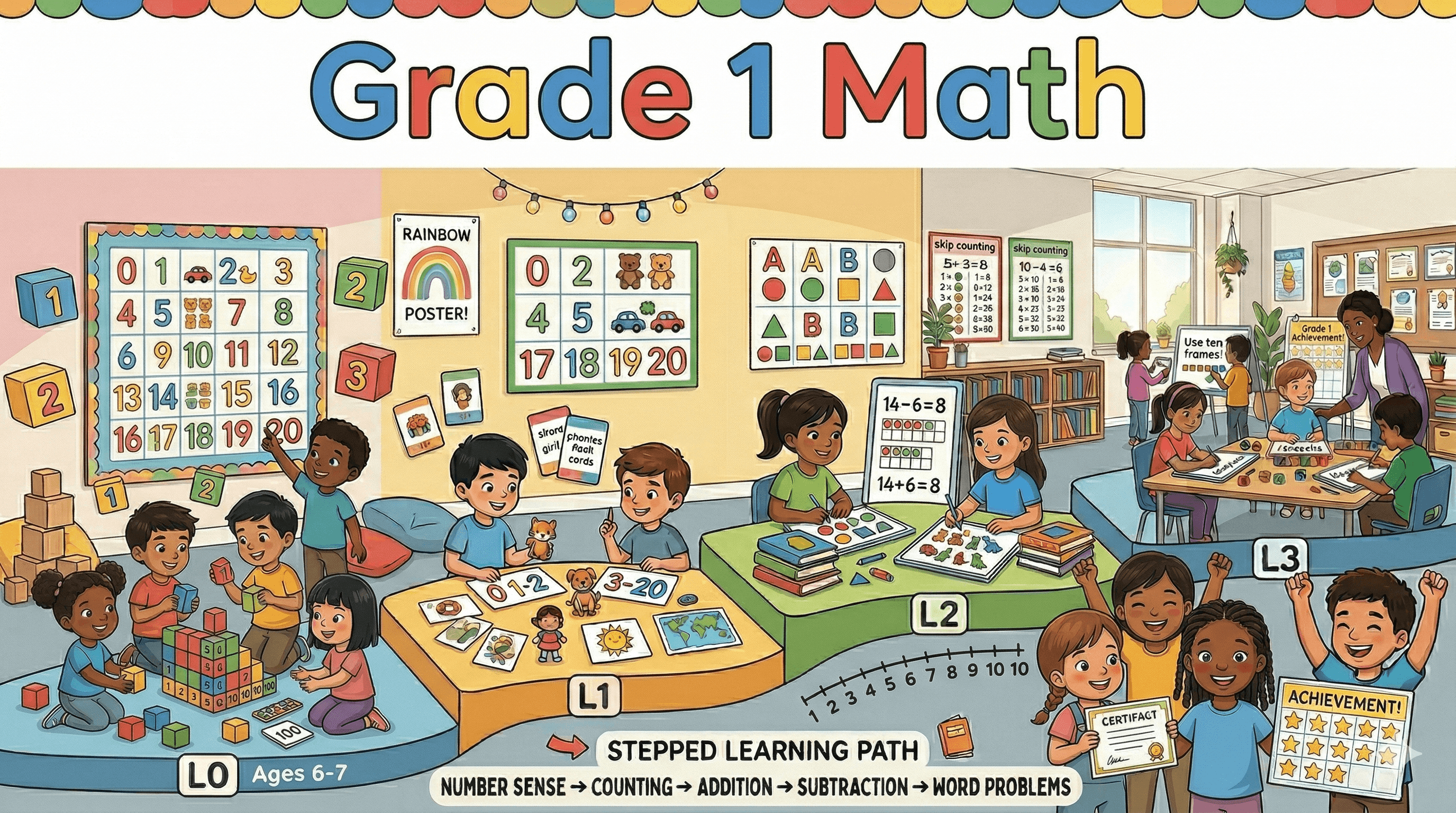
Grade 1 mathematics curriculum covering CA State Standards including operations, algebraic thinking, geometry, measurement, and data analysis.
Addition & Subtraction Mastery
Master addition and subtraction within 20, understand the relationship between operations, solve word problems, use strategies like counting on and making ten, represent situations with equations, and explain thinking clearly.
Place Value & Counting
Count to 120, understand tens and ones, compare two-digit numbers, and use place value understanding to add and subtract.
Measurement & Geometry
Measure lengths, tell time to the hour and half-hour, identify 2D and 3D shapes, partition shapes into equal parts, analyze data in graphs, and understand fractions.
Course Preview
Operations And Algebraic Thinking
- Represent and solve problems involving addition and subtraction.
- Understand and apply properties of operations and the relationship between addition and subtraction.
- Add and subtract within 20.
- Work with addition and subtraction equations.
Number And Operations In Base Ten
- Extend the counting sequence.
- Understand place value.
- Use place value understanding and properties of operations to add and subtract.
Measurement And Data
- Measure lengths indirectly and by iterating length units.
- Tell and write time.
- Represent and interpret data.
- Geometry
- Reason with shapes and their attributes.
Geometry
- Reason with shapes and their attributes.
Foundational Mathematical Practices:
- Make sense of problems and persevere in solving them.
- Reason abstractly and quantitatively.
- Construct viable arguments and critique the reasoning of others.
- Model with mathematics.
- Use appropriate tools strategically.
- Attend to precision.
- Look for and make use of structure.
- Look for and express regularity in repeated reasoning
List Of Math Topics/Skills Will Be Covered In Class
Skills will include addition vocabulary words with definitions, addition key words, addition within 20 to solve word problems, addition situations (adding to, taking from, putting together), 8 addition strategies (zero facts, turn-around facts, counting on, doubles facts, near doubles, make a ten, part part whole, combine numbers), missing addends, and relate counting to addition.
Subtraction
Skills will include subtraction vocabulary words with definitions, subtraction keywords, subtraction within 20 to solve word problems, 8 subtraction strategies (subtracting zero, subtracting the same number, counting back, make a model, missing parts, counting up, think doubles, think addition to 10), ten frames, missing parts, number line subtraction, and fact families.
Measurement & Data
Skills will include types of measurement, tools to measure, ordering objects by length and height, organizing and representing data (tally marks, pictographs, and bar graphs), interpreting data, digital, analog, hour hand, minute hand, labeling minutes on a clock, practice using an interactive clock to tell time, telling time to the hour, half-hour, and quarter-hour.
Numbers & Operations
Skills will include counting to 120, reading and writing numbers to 120, counting forward from any number and ten frames / twenty frames, 1 more 1 less, greater than, less than, and equal to, missing numbers, part part whole, number bonds, and decomposing numbers, base ten, tens and ones, expanded form, groups of ten, and values of digits.
Geometry
Skills will include equal and unequal parts, partitioning shapes, identifying and writing fractions, 2D and 3D shapes, real world shapes, drawing shapes, determining shape characteristics (sides, corners, edges, vertices, and faces), composing and decomposing shapes, ways shapes move (slides, flips, and turns), congruent shapes, and symmetry. MONEY Skills will include coin identification, coin values, adding coins, penny, nickel, dime, quarter, money word problems, coin poems, and how to make different coin combinations.
Skills will be modified and adjusted based on student’s needs and ability. Second grade math skills will also be introduced based on students’ proficiency level.
30-40 sessions total based on class size and duration of class
Highlights Of Kmind Math Curriculum:
- The curriculum is developed based on a spiral approach in which concepts will be introduced, revisited, elevated, expanded, and challenged throughout the entire curriculum.
- Combining the methods of Singapore Math (focus on the concrete-pictorial-abstract method) and Beast Academy (an interactive program that challenges students to think about math concepts in a deeper way) to provide students a well-balanced learning opportunity.
- Include math talk, math logic puzzles, growth-mindset, and real-life, scenario-based math activities for almost every session to bring the purpose and value of learning math to life.
- Using the “I do, We do, You do” modeling teaching strategy to support and motivate students in the most age-appropriate way while still challenging them enough.
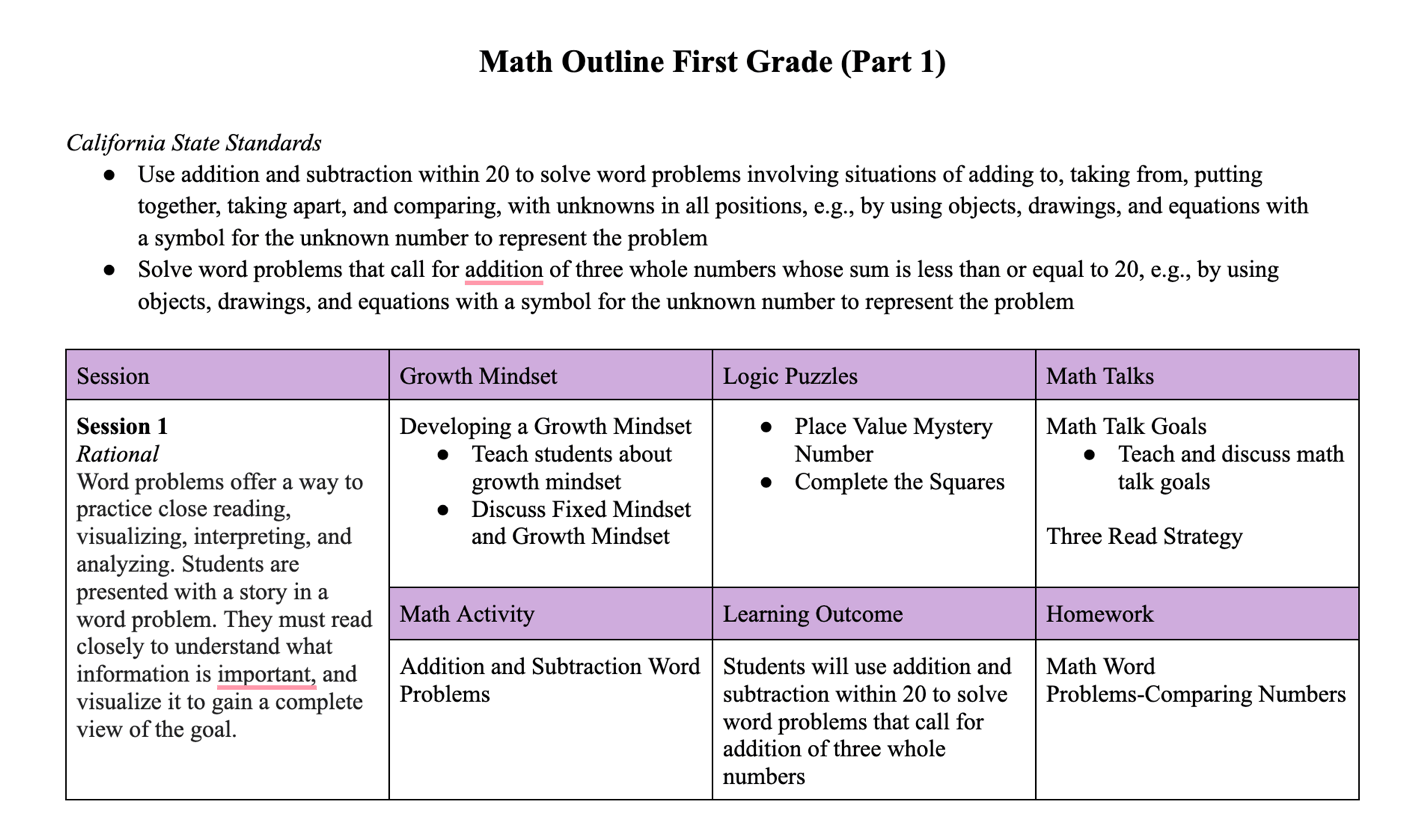
Example Of Outline——G1 Math, Part 1, Session 1