
Why Math is So Important?
By Kmind
Math is not only the most basic subject in school, but it is also one of the most important subjects to learn in life.
Math can help children understand pocket money, participate in family shopping or vacation budgeting, and save for toys and things they enjoy. Later in life, it will help them learn about contracts, bills, and taxes.
Mathematics helps children understand the world around them by helping them identify patterns. It assists them in building reasoning and problem-solving skills and even helps them predict what will happen in the future.
Math also allows children to:
-
Expand their analytical thinking.
-
Understand more easily how things operate.
-
Develop their capability to think.
-
See the importance of understanding and balance in all things.
-
Grow faster and sharper with numbers.
-
Connect with other aspects of life that rely on numbers.
-
Expand their awareness of the world.
Maths Activities for Children
Helping Kids Understand the Value of Math:
One way to help kids understand the importance of math is to get them to ponder the following questions:
-
Can games be used without numbers?
-
Can apps or software be programmed without math?
-
Can athletes train for a race and time themselves without mathematics?
-
How does a doctor know the amount of medicine for patients?
-
Can birthdays be remembered without numbers?
Cooking:
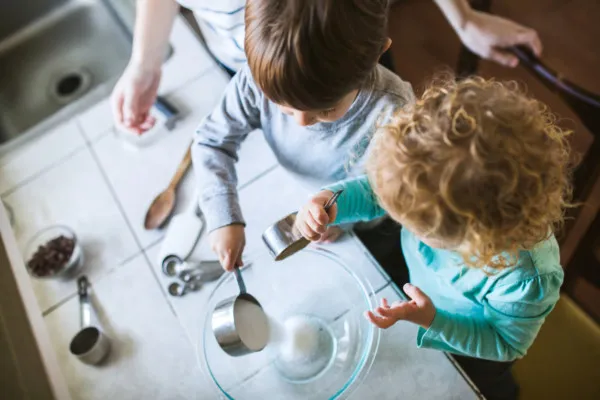
When cooking at home, ask your child: “The recipe calls for ‘3 tablespoons’ of salt. You only have a teaspoon or a soup spoon. How should we solve it?” or “The recipe calls for ‘2 cups,’ but you only have a quarter cup measuring tool and a half cup measuring tool. How much adds up to ‘2’?”
Questions like these could help children understand math, fractions, and conversions. The kitchen is a real-life school for kids of all ages.
Grocery Store:
Grocery shopping, or any other kind, can be a stressful chore when your kids are with you. In between the cries of “can we buy that?” and “Ick, asparagus!” you can make the trip more manageable by drawing on some math learning. Make a list while you’re there and ask your child what they think the total should be when you get up to the register. Asking them math questions while shopping will make math feel like an everyday activity instead of something that only happens at school or during homework time.
The store provides wonderful opportunities to practice estimating costs, creating and sticking to a budget, and using the scale to weigh produce. Look for opportunities to teach your children about making a budget, rounding to the nearest price, and learning about sales taxes.
Look at a Map:
We are always on the go. Have your child help in navigating to the next soccer practice, post office visit, or grocery store trip. Use a computer, phone or paper map. Point out the starting point and destination.
Letting children learn to read maps can help them develop three-dimensional imagination, thinking and logic skills.

The Bank:
Help your child open a savings account. He will have opportunities to practice balancing a budget/checkbook, understand how interest accrues, etc.
Sports:
Sports are full of numbers, whether it’s the score or the size of the playing field/court. Have your child explain the hitting percentage of her favorite baseball player or how the point system works in a football game. This way, she can understand these abstract classroom ideas in terms she knows, cares about, and understands.
Try Fun Math Games at Home
Beyond math facts, math games are great for making math more enjoyable. Many math in daily life activities games can be found online or purchased math-based video games to help them learn math facts in a fun way. Fun books that allow your child to practice math facts are also available, like math storybooks and comics.
Games:
- Fill the Jar with Hearts
Children spin to color a heart on their jar. Then they will gather and analyze their data on a bar graph.
- Roll the Dice to Count and More
Use your markers to write one action on each side of the wooden block die. To play, roll the wooden block die and one of your number dice at the same time. Do the action that your wooden block landed on the number of times that corresponds with your number die.
- Measure frog jumps
Have your children hop like frogs, leap like gazelles, or jump like a kangaroo. Then, pull out the ruler or measuring tape so they can measure the distances they’ve covered.
- Turn UNO into an active math game
Grab your UNO deck and get ready to move! Assign each color a movement (hop, touch toes, etc.). As kids draw the cards, everyone completes the movement the correct number of times. Skip and Reverse work as usual, but anyone who gets Draw Two has to draw two more cards and complete the actions on their own while others cheer them on.
- Go on a Shape Hunt.
As you are walking around your neighborhood, riding the bus, or driving in the car, search for different shapes and patterns. For example, doors are rectangles, stop signs are octagons and streetlights are circles.
Interactive Online Games:
Additional Websites:
****
Reference:
A. (2020, January 9). Creative ways to integrate math in your child’s daily life. Knoxville TN Magazines. https://knoxvilleparent.com/2013/09/creative-ways-to-integrate-math-in-your-childs-daily-life/
Dvd, M. T. (2009, January 22). Integrating Math into Everyday Life(Published in The Old Schoolhouse Magazine!). Math Tutor. https://www.mathtutordvd.com/public/162.cfm
Kids, P. (2021, February 20). 8 Easy Ideas to Add Math Into Your Daily Routine | Parenting Tips & Advice. PBS KIDS for Parents. https://www.pbs.org/parents/thrive/8-easy-ideas-to-add-math-into-your-daily-routine
Math Activities Parents Can Do With Children While at Home. (2022, June 15). Verywell Family. https://www.verywellfamily.com/everyday-home-math-activities-621043
Math Matters in Everyday Life - NIU - Math Matters. (2022). Northern Illinois University. https://www.niu.edu/mathmatters/everyday-life/index.shtml
Paul, M. (2022, May 4). The best way to integrate math into the daily life activities. Orchids The International School. https://www.orchidsinternationalschool.com/blog/child-learning/mathematics-activities-for-kids/
Explore Our Courses
Discover courses designed to help your child thrive

Science Research Project
Develop scientific inquiry and research skills through hands-on projects, helping 3rd to 12th graders learn the scientific method, experimental design, and data analysis.

Leadership Development
Cultivate leadership qualities through communication training, teamwork exercises, and ethical decision-making practice for students K-12.

Public Speaking and Debate
Master public speaking and competitive debate through structured training in argumentation, rhetoric, and persuasive communication for grades 3-12.