
The School Lunch History and Standards
By Kmind
Under California’s Universal Meals Program, all public school students in grades transitional kindergarten through 12, regardless of their parents’ income, are eligible for free breakfast and lunch. The Los Angeles Unified School District is providing even more help, making three free meals a day available to students.
California is the first state to enact free school meals for students served by public school districts, county offices of education and charter schools, whether or not they’re eligible for the National School Lunch Program’s free or reduced-price meals.
School lunches can be controversial today, but that wasn’t always the case.
The School Lunch History
How Did School Lunches Begin?
Before 1930
During [the Industrial Revolution], child labor prevented school-age children from accessing education and a path to a better life. By 1900, the laws that mandate all children under the age of 14 must receive an education were passed by 34 states. These laws aimed to provide the means for children to escape lifelong poverty.
Providing meals during school hours was a natural outcome of these laws, which kept children in classrooms for most of their day. School lunches began in Boston and Philadelphia, where welfare organizations provided meals to schoolchildren for a penny each. This ground-breaking advancement for children caught on in other cities and continued to grow nationwide with positive results.
The response these programs received was overwhelmingly positive. As one report submitted to The Journal of Home Economics in 1910 describes, “the teachers [in Boston] are unanimous in the belief that the luncheons are helping the children both physically and mentally.”
The 1930s
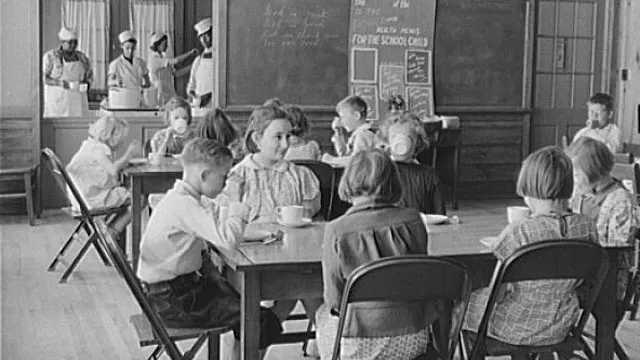
When [the Great Depression] hit, farms had a surplus, but no way to pay laborers for their harvest or to get the farm yields to market. Children were hit the hardest, and the effects of their malnutrition were unmistakable. FDR’s New Deal aimed to remedy the impacts of malnutrition and hunger by buying the farmers’ surplus, hiring women to prepare meals for school hours, and providing school lunches for children across the country.
1940-2000
However, the school lunch program was not a permanent mandate. During [WWII], another school lunch crisis hit. Food was being rationed, women were working in factories, and the availability of school lunches plummeted.
In 1946, Congress recognized the need to keep children healthy and fed at school and passed the [National School Lunch Act].
And [The National School Lunch Program (NSLP)] which provides nutritionally balanced, low-cost or free lunches to children each school day, was established under the National School Lunch Act.
Schools had to agree to provide meals that met the minimum nutritional requirements prescribed by the U.S. Secretary of Agriculture. These lunches were defined as one of three types: Type A, Type B, or Type C.
The Type A lunch was defined as consisting of:
-
½ pint fluid whole milk
-
Protein-rich food consisting of one of the following or a combination:
o 2 ounces of lean meat, fish or poultry
o 2 ounces of cheese
o 1 egg
o ½ cup of cooked dry beans or peas
o 4 Tablespoons of peanut butter
-
¾ cup serving of two or more vegetables or fruits, or both
-
1 serving of bread, rolls, muffins, etc.
-
2 teaspoons of butter or fortified margarine
The Type A meal pattern lasted 35 years (1946-1977) with only minor changes.
Type B lunches contained smaller quantities of the components in the Type A lunch and were served primarily in schools with inadequate cooking facilities.
Type C lunches consisted of only ½ pint of whole fluid milk served as a beverage.
This strength and support for school-sponsored lunches continued to grow until the Reagan administration when funding was drastically cut, nutrition standards to provide healthy meals were virtually non-existing, and cases of childhood obesity increased exponentially.
21st Century
In 2010, to return to the original intentions of school lunch programs, Congress passed the Healthy, Hunger-Free Kids Act of 2010 (HHFKA), which allows the Department of Agriculture to overhaul school meals to meet new nutrition standards.
In addition to establishing new program audit requirements (Administrative Review) and updated nutrition standards, USDA was granted the authority to set nutrition standards for all food products sold on school grounds during the school day. Additional authority was also given over food safety matters, including guidelines for recalling or putting administrative holds on suspect food products.
A 2016 report declares that, despite the hubbub in cafeterias across the country, the new act is indeed providing kids with healthier food at school.
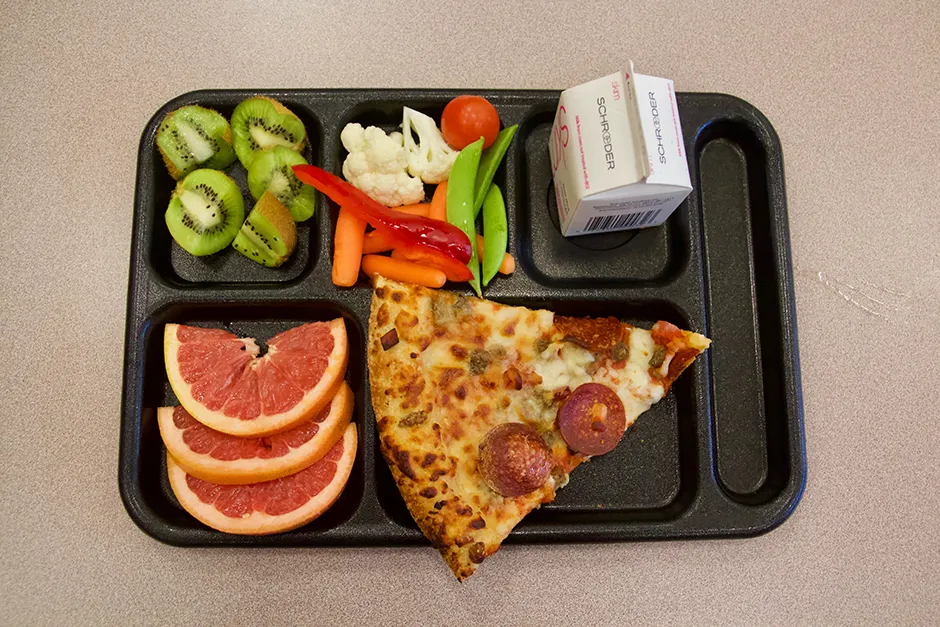
A January 2012 USDA study rated the USDA foods provided through NSLP at 77.2 on the Healthy Eating Index (HEI), significantly higher than the HEI score of 55.0 for the average American child’s diet.
School Breakfast and Lunch Standards
The January 2011 [Nutrition Standards in the National School Lunch and School Breakfast Programs] proposed rule sought to improve lunches and breakfasts by requiring schools to:
-
Offer fruits and vegetables as two separate meal components;
-
Offer fruit daily at breakfast and lunch;
-
Offer vegetables daily at lunch, including specific vegetable subgroups weekly (dark green, orange, legumes, and other as defined in the 2005 Dietary Guidelines) and a limited quantity of starchy vegetables throughout the week;
-
Offer whole grains: half of the grains would be whole grain-rich upon implementation of the rule and all grains would be whole-grain rich two years post implementation;
-
Offer a daily meat/meat alternate at breakfast;
-
Offer fluid milk that is fat-free (unflavored and flavored) and low-fat (unflavored only);
-
Offer meals that meet specific calorie ranges for each age/grade group;
-
Reduce the sodium content of meals gradually over a 10-year period through two intermediate sodium targets at two and four years post implementation;
-
Prepare meals using food products or ingredients that contain zero grams of trans fat per serving;
-
Require students to select a fruit or a vegetable as part of the reimbursable meal;
-
Use a single food-based menu planning approach; and
-
Use narrower age/grade groups for menu planning.
USDA is finalized its Nov. 25, 2020, proposed rulemaking regarding child nutrition meal pattern requirements. This rule will become effective July 1, 2022.
This rule finalizes the proposed milk provision by allowing local operators of the National School Lunch Program and School Breakfast Program to [offer flavored, low-fat milk (1 percent fat) for students in grades K through 12 and for sale as a competitive beverage].
It also allows flavored, low-fat milk in the Special Milk Program for Children and in the Child and Adult Care Food Program for participants ages 6 and older. Beginning in SY 2022-2023, this final rule [requires at least 80 percent of the weekly grains in the school lunch and breakfast menus to be the whole grain-rich].
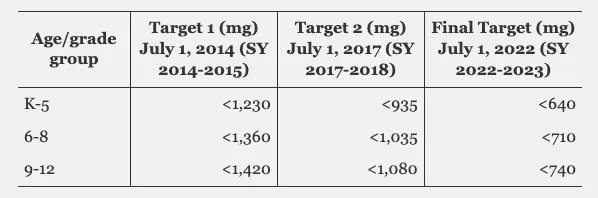
Lastly, this final rule will modify the proposed [sodium standards and establish Sodium Target 1 (see the table below) as the sodium limit for school lunch and breakfast in SY 2022-2023 as proposed], but implement a Sodium Interim Target 1A effective for school lunch beginning in SY 2023-2024.
Parents’ biggest concern is that school lunches may be “not nutritious enough” and that preparing packed lunches is time-consuming. Through the Nutrition Standards in the National School Lunch and School Breakfast Programs, we can see that the school lunch is making every effort to ensure the children’s nutritional intake. Next week we will continue to discuss how to address picky eaters and get better nutrition for children to grow up healthy.
Reference
- Child Nutrition Programs: Transitional Standards for Milk, Whole Grains, and Sodium. (2022). Federal Register. https://www.federalregister.gov/documents/2022/02/07/2022-02327/child-nutrition-programs-transitional-standards-for-milk-whole-grains-and-sodium
- Garcia, K., & Healey, J. (2022, August 15). Free school lunch available to California public schools. Los Angeles Times. https://www.latimes.com/california/story/2022-08-15/free-for-all-california-public-school-students-at-least-two-meals-a-day
- Rude, E. (2016, September 19). An Abbreviated History of School Lunch in America. Time. https://time.com/4496771/school-lunch-history/
- School Meals | Healthy Schools | CDC. (2022). CDC. https://www.cdc.gov/healthyschools/npao/schoolmeals.htm
- Solutions, H. S. (2020, March 3). The School Lunch: A Brief History. Harris School Solutions. https://harrisschoolsolutions.com/blogposts/the-school-lunch-a-brief-history/
Explore Our Courses
Discover courses designed to help your child thrive
Phonics
Build a strong reading foundation through systematic phonics instruction, helping Pre-K to 1st graders master letter sounds, blending, and decoding skills.

Leadership Development
Cultivate leadership qualities through communication training, teamwork exercises, and ethical decision-making practice for students K-12.
Math
Build strong mathematical foundations through hands-on problem-solving and conceptual understanding, helping Pre-K to 2nd graders develop number sense and critical thinking skills.