
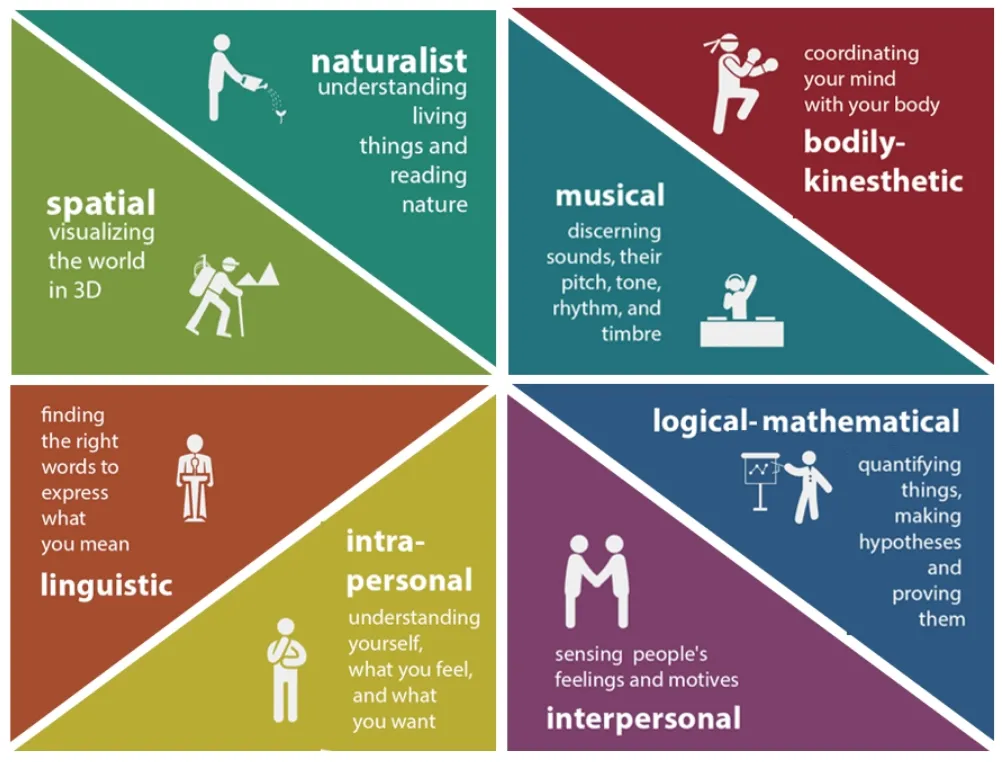
Logical-mathematical intelligence, one of Howard Gardner's eight multiple intelligences, involves th...
By Kmind
Image Credits: Thrive Global, 2019.
For more information on multiple intelligences theory, please see the previous Kmind article [“8 Types of Intelligence- Howard Gardner’s Theory of Multiple Intelligences”].
Logical-mathematical intelligence
When we say the word “smart”, this type of intelligence is usually what we think of. People with logical intelligence tend to get good grades in school and are typically good with numbers and analyses. They are good at figuring things out, such as puzzles, math problems, or riddles. These people tend to thrive in areas such as engineering, banking, and programming. They have good memories of formulas and concepts, and because of this, tend to be good test-takers. Early signs of this intelligence are being able to do quick and accurate mental math, and being a quick learner, especially in the mathematical area.
Characteristics of Logical-mathematical intelligence
-
Excellent at thinking about numbers, patterns, and their relationship
-
Excellent at solving complex problems and computations
-
Tend to do scientific experiments
-
Like to think about abstract ideas
-
Exceptional analyzing skills
-
Maximum organizational and classification abilities
Potential Career Choices
-
Accountant
-
Actuary
-
Auditor
-
Bookkeeper
-
Chemical engineer
-
Computer programmer
-
Computer technician
-
Database designer
-
Economist
-
Electronic engineer
-
Financial consultant
-
Mathematician
-
Mechanical engineer
-
Network analyst
-
Scientist
-
Statistician
-
Systems analyst
Milestones of Logical-Mathematical Intelligence
Kindergartners (age 5 years)
-
Add by counting the fingers on one hand --- 1, 2, 3, 4, 5 --- and starting with 6 on the second hand
-
Identify the larger of two numbers and recognize numerals up to 20
-
Copy or draw symmetrical shapes
-
Start using very basic maps to find a “hidden treasure”
-
Begin to understand basic time concepts, like morning or days of the week
-
Follow multi-step directions that use words like first and next
-
Understand the meaning of words like unlikely or possible
First and Second Graders
-
Predict what comes next in a pattern and create own patterns
-
Know the difference between two- and three-dimensional shapes and name the basic ones (cubes, cones, cylinders)
-
Count to 100 by ones, twos, fives, and tens
-
Write and recognize the numerals 0 to 100, and the words for numbers from one to twenty
-
Do basic addition and subtraction up to 20
-
Read and create a simple bar graph
-
Recognize and know the value of coins
Third Graders
-
Move from using hands-on methods to using paper and pencil to work out math problems
-
Work with money
-
Do addition and subtraction with regrouping (also known as borrowing)
-
Understand place value well enough to solve problems with decimal points
-
Know how to do multiplication and division with help from fact families (collections of related math facts, like 3 × 4 = 12 and 4 × 3 = 12)
-
Create a number sentence or equation from a word problem
Fourth and Fifth Graders
-
Start applying math concepts to the real world (like cutting a recipe in half)
-
Practice using more than one way to solve problems
-
Write and compare fractions and decimals and put them in order on a number line
-
Compare numbers using > (greater than) and < (less than)
-
Start two- and three-digit multiplication (like 312 × 23)
-
Complete long division, with or without remainders
-
Estimate and round
Activities to Enhance Logical-Mathematical Intelligence
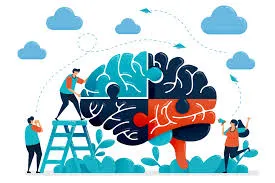
Solve Brain Puzzles
Almost everyone likes intelligence questions, riddles, and puzzles. In fact, these exercises are just activities for mathematical logical intelligence in different forms.
Solving logic puzzles that increase your child’s logical thinking does not take much time and can be extremely enjoyable.
Games with dot cards
Encourage children to quickly “see” how many dots are on the cards---particularly for cards with three or fewer dots. When children subitize and immediately “know” five dots, you might ask, “How did you see five dots so quickly? Did you group them?” Children do not need to count one by one for every card. If children always count one by one, they sometimes become less proficient at subitizing.
Play Board Games
Board games are a great way to develop strategic thinking skills and logical-mathematical intelligence.
They are beneficial as one of the adult logical-mathematical intelligence activities, just as for children. Not surprisingly, there are so many popular board games!
-
Settlers of Catan
-
 Clue
Clue -
Forbidden Island
-
Dominion
-
Pandemic
-
7 Wonders
-
Smallworld
Write Stories
A story is a textual presentation of an event that occurred somewhere. Writing about it involves presenting sentences in a logical manner. The learners are trying to develop logical intelligence employ knowledge of patterns and orders to create stories.
Explaining how events happened, concentrating on the feelings associated with those, and their presentation in a meaningful manner make one clearly aware of the patterns and logic. Thus, one can benefit from this activity a lot while trying to attain mathematical-logical intelligence.
Learn tongue-twisters

“She sells sea shells on the seashore.” Almost all of us have enjoyed iterating these tongue-twisters in our early learning stage. These are sentences that comprise words with the same initial letter. While voicing them out, the chances of making mistakes are pretty high if you have not put the proper concentration into the activity.
Thus, you are actually putting logical knowledge or sequencing skills into action while learning tongue-twisters. Please see the previous Kmind article, [“Fun Tongue Twisters for Your Kids,”] for more information on tongue twisters.
Do Research Projects
This exercise can be one of the best logical-mathematical intelligence activities for reading and organizing what they learn!
All kids who have logical-mathematical intelligence enjoy doing research projects usually. You can turn this interest into a fun project!
Choose a topic with your kids that can be interesting for them. It can be related to planets, animals, or anything they prefer. Tell them to collect enough information, then create and organize some worksheets! You can guide younger kids if they need your help.
Learn Coding
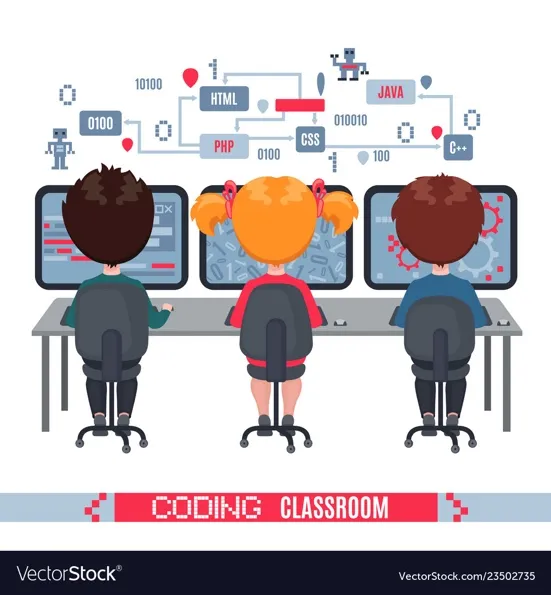
Coding is one of the most excellent examples of logical-mathematical intelligence activities.
It requires using so many skills simultaneously, like problem-solving, math, language, etc., so kids can discover their abilities in the world of coding even at such a young age!
Reference:
www.multipleintelligencesoasis.org
fairborndigital.us
Explore Our Courses
Discover courses designed to help your child thrive
Phonics
Build a strong reading foundation through systematic phonics instruction, helping Pre-K to 1st graders master letter sounds, blending, and decoding skills.

Public Speaking and Debate
Master public speaking and competitive debate through structured training in argumentation, rhetoric, and persuasive communication for grades 3-12.

Social Emotional Learning
Develop essential life skills including self-awareness, emotional regulation, empathy, and relationship building through evidence-based SEL curriculum.