
How to Stimulate Your Child's Potential: The Zone of Proximal Development Theory
By Kmind
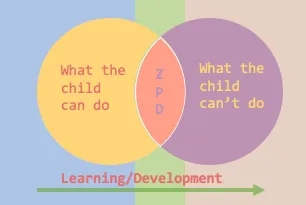
What is the zone of proximal development theory (ZPD):
The zone of proximal development (ZPD), or zone of potential development, refers to the range of abilities an individual can perform with the guidance of an expert, but cannot yet perform on their own.
Developed by psychologist Lev Vygotsky, this learning theory may be observed in a classroom setting or anywhere else where an individual has the opportunity to develop new skills.
Why ZPD is important:
The theory suggests that child development is not determined at any time by the mature part alone. In addition to the current level of development, the potential level of development of the child should not be underestimated. In both school and home education, parents and teachers should not focus on the past development of the child, but on the future development of the child, and constantly motivate the child. Only in this way can the child’s potential development level continue to improve and we can see more possibilities for the child’s future.
Stages of ZPD:
- Task a Learner Cannot Accomplish With Assistance
Tasks that are outside of the learner’s ZPD are those that are unable to be completed even with the help of an expert.
If the task isn’t within the learner’s ZPD, the expert may look to decrease the level of difficulty and find tasks that are more appropriate given the learner’s skill level.
- Tasks a Learner Can Accomplish With Assistance
When a learner is close to mastering a skill set required to complete a task, but still needs the guidance of an expert to do so, they are considered to be in their zone of proximal development.
In this situation, an expert may use various techniques to help the learner better understand the concepts and skills required to perform a task on their own.
- Tasks a Learner Can Accomplish Without Assistance
In this phase, the learner is able to complete tasks independently and has mastered the skill set required to do so. The learner does not need the help of an expert.
When a learner has reached this stage, the expert may increase the task difficulty level in order to find the learner’s next ZPD and encourage further learning.
How to Improve your child’s cognitive development:
According to Vygotsky’s theory, the most effective teaching is to give children challenging material and to help them master that material. Although children may need a lot of help at first, Vygotsky believed that as long as the problems did not exceed the upper limit of the child’s ZPD, they would help the child achieve cognitive development.
- Interest-led to explore children’s potential
Vygotsky’s sense values the child’s developmental potential, which is the potential unrealized ability of the mind and body, or an inherent possibility, so to speak. The prerequisite for the development of potential is the child’s preference and concern in a certain area, and when something can be new to the child, it will cause him concern. Therefore, parents should not only adapt to their child’s current level of development, but should adapt to the ZPD, expose child to things beyond his current level, and properly guide their child’s interest in learning to stay ahead of development.
- Parental involvement, providing developmental pathways
The ZPD theory provides a way to understand children’s development and is based on the important idea that children develop primarily through social interaction with adults or more experienced peers. With the help of adults within this zone, children are more likely to absorb what they cannot absorb on their own. When a child encounters a problem, parents can use the problem to provide assistance to the child, help the child focus attention and provide new ideas, allowing the child to receive new learning and achieve faster development within the zone of most recent development. Children who work with adults not only gain much knowledge, but they are able to transfer their learning experiences to subsequent independent programs.
- Build self-confidence, children will grow up happily
Whatever you do, confidence comes from the accumulation of several successful experiences. The ZPD is the best time to give your child his first successful experience. When a child is faced with something that is beyond his current level of ability to achieve, and with the right guidance from parents, he solves the problem successfully and has an elevated outcome, a sense of accomplishment will naturally arise. Something that gives a child a sense of accomplishment will make him enjoy it and give him confidence. The child is naturally relaxed and happy when doing something with confidence.
A child’s ZPDs are continuous, so there are many opportunities for parents to tap into them. Use the ZPD for effective guidance and inspiration to keep your child happy.
Reference: verywellfamily.com
Explore Our Courses
Discover courses designed to help your child thrive

Writing Class
Master the art of written expression through structured writing workshops, helping 1st to 6th graders develop storytelling, essay writing, and creative composition skills.

Reading and Writing
Develop comprehensive literacy skills through engaging reading comprehension and creative writing activities designed for Kindergarten to 6th grade students.
Phonics
Build a strong reading foundation through systematic phonics instruction, helping Pre-K to 1st graders master letter sounds, blending, and decoding skills.