

How to Have a Smooth and Energetic Morning?
By Kmind
A great day starts with a great start, but once school starts, rushed and frantic mornings are often the norm.
Out of necessity, most of us are focused on meeting our children’s physical needs in the morning; making sure they eat a good breakfast, find their school bags, and even put on their shoes are no small tasks!
But what if we could also prepare our children mentally and emotionally? The motivational theory of emotions, developed by R.W. Leeper, emphasizes that emotions are positive motivational and perceptual forces that unconsciously control our behavior and guide its direction.
Reconnect
“For kids, going to bed at night means they’re on their own,” says Betsy Brown Braun, a child development and behavior expert.” I look mornings as the oasis after the drought.” In other words, kids may especially need family company in the morning to re-establish a sense of security that may not exactly align with your desire to rush everyone out the door.
Taking the time to reconnect with your child after a long night can make the morning go smoothly:
-
Express your love for your child
-
Spend 5 minutes snuggling together
-
Hold hands on the way to breakfast
-
Listen to the radio together at breakfast or on the way to school and talk about favorite parts or things you’ve learned.
If you connect with your kids first, they’ll be more likely to follow your morning instructions.
Create a Routine
Parents may not be drawn to routine, but for kids, it’s indispensable! It’s helpful to perform tasks in the same order every morning. This way your child learns a rhythm that he will independently begin to follow. Your child wakes, eats breakfast, gets dressed, brushes teeth, puts on sunscreen, brushes hair, puts on shoes, and so on…in that order. Each of these takes place in a designated spot in the house. Having everything in a specific place means that you’re not scrambling around trying to find things, and your child knows where to go for them. Performing tasks in a regular manner will allow your child to anticipate and sometimes initiate what to do next.
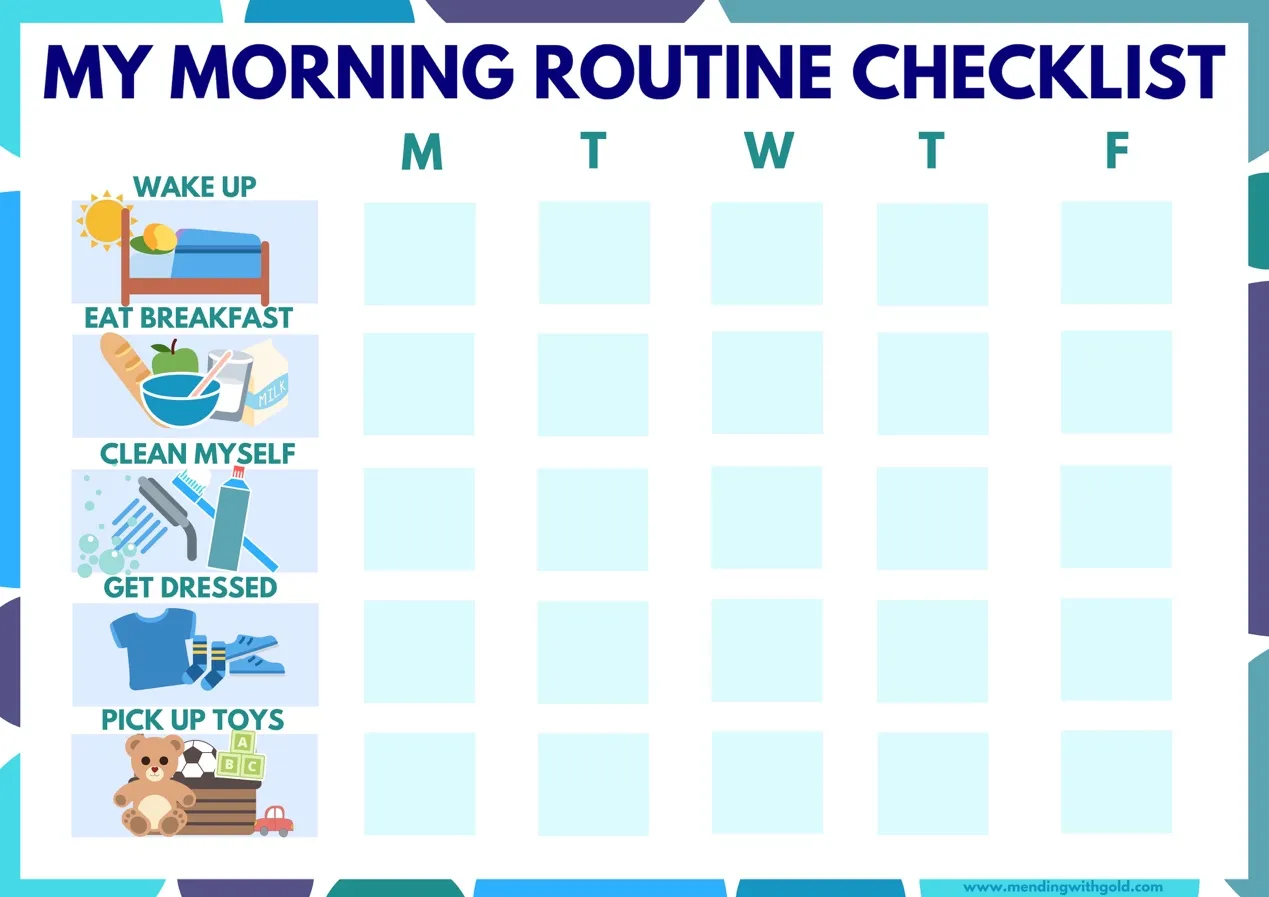 Make a list of all the things your child needs to do before leaving for school and make a routine checklist. For younger kids, you can use pictures instead of words. You can invite your child to participate in the process and work out a process that you are all satisfied with. Be sure to review each step together in detail before starting. Discuss and consider each item to see where issues might arise, or if the steps need to be put in a different order. And then post it in a place where you can see it regularly, such as on your child’s bedroom door. This will remind your child of what needs to be done each morning, reduce unnecessary nagging, and give him or her a sense of trust that you believe he or she can do it.
Then, set the time at key points. You need to adjust the time points according to the characteristics of your child. The advantage of this is that it gives your child certain rules and boundaries to ensure that you leave the house on time, and your child also has the space to make his or her own arrangements.
Stay Calm
Have you ever noticed your anxiety has the effect of making your kids move in slow-mo? You’ll be less stressed, which they will notice and may even mirror your calm behavior. Some children are dawdling because they don’t want to go to school, while others are affected by your anxiety and fear of confronting your emotions, hesitating and not knowing what to do. So if your child is procrastinating or dawdling, stop what you are doing and see if a hand on the arm or squatting down to make eye contact gets him or her moving again.
Set Positive Intentions
Research shows that saying affirmations about ourselves out loud can actually change our mindset and behavior, and even improve the way we see the world.

Practice saying affirmations out loud, such as “Today is going to be an awesome day,” “I like going to school,” and “I can be anything I want to be!” Don’t be shy and trust your statements. Know that the more you practice it, the more likely it will happen.
How Do I Wake Up My Child?
Yelling, slapping your child or pulling the covers off your child may cause your child to be irritable and inattentive throughout the day. This may not only affect your child’s academic performance but may also have lifelong consequences.
So what kind of wake-up call would be more positive and effective?
Advance Notice
Learn to respect your child. Before going to bed the night before, tell your child what time you will wake him or her up, even if he or she is still young and does not know the concept of time. This will help your child to develop a sense of time, and it will prepare your child so that even if he or she will be lazy when woken up on the second day, he or she will know that it is time to get up after a while.

Soft Voice
Whisper gently in your child’s ear to wake him or her up and also pat on the back to make him or her feel loved by parents. Be firm and gentle in your tone of voice. Or use soothing music to wake your child up, which can refresh your mind and improve your child’s musicality. It is best to let your child choose the wake-up music the night before. This way, when the music is played in the morning, he or she will know that it is time to wake up.
Diversionary Attention
Some children grunt and even throw tantrums when their parents call them to wake up. In this situation, parents should not get angry. You can gently pat the child, hug the child, and talk to the child about:
-
Which clothes are you going to wear today?
-
Which teacher will you meet at school?
-
Which students will you play games with?
-
What lessons will you learn?
Let the Chips Fall
As they should during the rest of your day, let your child’s actions dictate the consequences, even if it makes you late or saddles you with a whiny kid on the way to school.
Wake up your child with a distraction, talk to your child slowly, you and I believe, talk about topics that interest your child. I believe your child will soon become awake. Because children are very smart, they also know that you talk to them, in fact, is to wake them up, just in a different way.

Let the child face the natural consequences of being late
If all measures fail, children need to face the natural consequences of sleeping in and being late. This helps them understand the actions and consequences. Consequences they may face for being late may include being late or missing school, resulting in extra homework, facing detention at school, or missing out on fun activities, camps, or play dates. Sometimes, the consequence may be missing breakfast. Eventually, most children will probably take these consequences seriously and get up on time.
Once you have found a wake-up routine that works well for your child, don’t change it. A fixed wake-up routine gives your child the greatest sense of security and fosters attachment to his or her parents.
Reference
- Baedke, M. (2021, January 2). 5 Steps to a Positive Morning Routine for Kids. Sioux Falls Lutheran School. Retrieved October 7, 2022, from https://www.siouxfallslutheran.com/school-blog/2021/1/2/5-steps-to-a-positive-morning-routine-for-kids
- biglifejournal.com. (n.d.). 5 Steps to a Positive Morning Routine for Kids. Big Life Journal. Retrieved October 7, 2022, from https://biglifejournal.com/blogs/blog/create-positive-morning-routine-kids
- Dixon, H. (2022, August 8). How to Set a Morning Routine for Kids. Tinybeans. Retrieved October 7, 2022, from https://tinybeans.com/easy-morning-routine-for-kids/slide/2/
- Emmons, S. (n.d.). De-Stress Your Morning Routine. Parenting. https://www.parenting.com/activities/kids/de-stress-your-morning-routine/
- How Do I Wake Up My Child for School? 12 Effective Ways. (2021, June 23). MedicineNet. Retrieved October 7, 2022, from https://www.medicinenet.com/how_do_i_wake_up_my_child_for_school/article.htm
Explore Our Courses
Discover courses designed to help your child thrive

Leadership Development
Cultivate leadership qualities through communication training, teamwork exercises, and ethical decision-making practice for students K-12.

Writing Class
Master the art of written expression through structured writing workshops, helping 1st to 6th graders develop storytelling, essay writing, and creative composition skills.
Math
Build strong mathematical foundations through hands-on problem-solving and conceptual understanding, helping Pre-K to 2nd graders develop number sense and critical thinking skills.